The short answer
If you read your partner's AI chats and something in them hurt, do not decide what it means yet. A chat is what someone typed, in one moment, to a tool that answers back. It is not a verdict on your relationship. Wait until you are both calm, tell your partner plainly what you saw and how it landed, and ask what they were working through. Then agree on what stays private in your AI use, before it happens again.
By Jocelyn Johnson, relationship coach and founder of Happy Partners AI
Why this is suddenly a couples issue
TIME's Angela Haupt recently reported on a new kind of discovery: partners finding each other's AI chat histories. The therapists she spoke with describe couples who found a partner asking AI whether to break up, working out how to bring up something scary, or sharing things they had never said out loud. Most of those couples had never talked about whether a chat with AI counts as private, the way a journal does.
That gap is the real problem. Two people can share a bed, a budget and a calendar and still hold completely different unspoken rules about a space neither of them had a word for until recently.

What the chats can and cannot tell you
- They show a moment, not a decision. People type things after a fight that they do not believe once they have cooled down. "What if we broke up?" is often a way of testing a feeling, not announcing a plan.
- They show one side. An AI tool that agrees with a complaint can feel like a second opinion. It is not. It heard one version, from one person, on one bad night.
- They can still reveal something real. If the same worry shows up again and again, it may be something your partner has been carrying and has not found a way to say to you. That is worth a conversation, not a trial.
The first 24 hours
- Do not confront in the moment. You will be flooded. Take the walk, drink the water.
- Write down what hurt, in your own words. "I felt dismissed" is useful. "They think I'm a failure" is a conclusion you cannot prove yet.
- Do not send screenshots to friends. It turns a private hurt into a public case.
- Pick a time to talk. "Can we talk tonight at seven? There is something I need to bring up, and I want to do it well."
The conversation: what to say
If you are the one who read the chats:
"I looked at something I should not have, and I want to own that. I saw what you wrote about us, and it hurt. I would like to understand what you were working through. I am not trying to win. I want to hear it."
If you are the one who wrote them:
"I was trying to work out how to say something I was scared to say to you. I am sorry it was found like this, and I am sorry for how some of it was worded. Here is what I was actually trying to get to."
Both of you are allowed to be hurt. One person crossed a boundary by reading, and the other may have shared things about you that they had not shared with you. Neither cancels the other. Repair needs both.
Five questions that open it up
- What were you trying to figure out when you wrote that?
- Is there anything you find easier to say to AI than to me?
- What would make it easier to bring it to me first?
- What part of it do you still feel, now that you have cooled down?
- What do you need from me this week?
Set your AI agreement (before the next time)
You probably have rules about phones, money and friends. Add AI. Talk through these together:
- Which topics are private, and which are fine to share?
- Is it ever okay to open each other's accounts or histories?
- Are we okay with pasting each other's texts into an AI tool?
- If we share an account or subscription, who can see what?
- When will we revisit this? (Put it on the calendar. Your answers will change.)
If you would rather do this inside a structured conversation, a weekly relationship check-in is a natural home for it.
If you use AI to think about your relationship, here is a safer way to do it
Nothing is wrong with thinking out loud. Where you do it, and how, matters. Try a prompt that keeps the focus on you:
"I am hurt by something. Help me sort out what I am feeling and what I want to ask for. Ask me one question at a time. Do not tell me who is right."
Notice what that prompt does not do. It does not ask the tool to decide what your partner thinks, or to hand you a verdict. Only your partner can tell you what is in their head.
Private space and shared space are different jobs
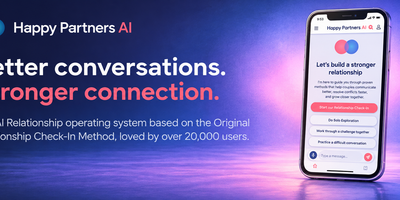
A general-purpose AI tool treats your grocery list and your marriage the same way: one open room, one history. A relationship deserves a space that was built for it. In the Happy Partners AI app, you have a private space for your own thoughts, which your partner cannot see, and shared sessions that you take part in together. Coach Joce is AI-powered relationship coaching, not therapy, and the point is to help you talk to each other, not to replace it.
Coach Joce says: "Curiosity is intimacy. Listen more than you speak."
Common questions
Was it wrong to read their chats?
Reading someone's private history without asking crosses a line for most people, and it is fair to own that. It does not cancel the hurt you felt. Say both things: "I should not have looked," and "what I saw hurt."
Does venting to AI mean my partner wants to leave?
Not by itself. People vent, rehearse and test thoughts in private. What matters is whether the same worry keeps coming back, and whether they have a way to bring it to you. Ask, do not assume.
Is using AI for relationship advice a bad idea?
It can help you think and rehearse a hard conversation. It becomes a problem when it is the only place you are honest, or when it only ever hears your side. Use it as a bridge to your partner, not a replacement for them.
Should we use the same account?
If you share an account, you share its history. Decide on purpose whether that is what you both want.
Want a place to practice the conversation?
You can rehearse what you want to say, with your own private space first and your partner invited when you are ready. Try the Happy Partners AI app, where your first sessions are free. For how this differs from a general AI tool, see why choose a CBT-grounded AI relationship coach over generic tools and our common questions about AI relationship coaching.
Happy Partners helps couples build the skills to stay together. Coach Joce provides AI-powered relationship coaching, not therapy or crisis support. Coach Joce is not a therapist. If you're experiencing abuse, a safety concern, or a mental health crisis, please seek human support or contact the 988 Lifeline or thehotline.org.